

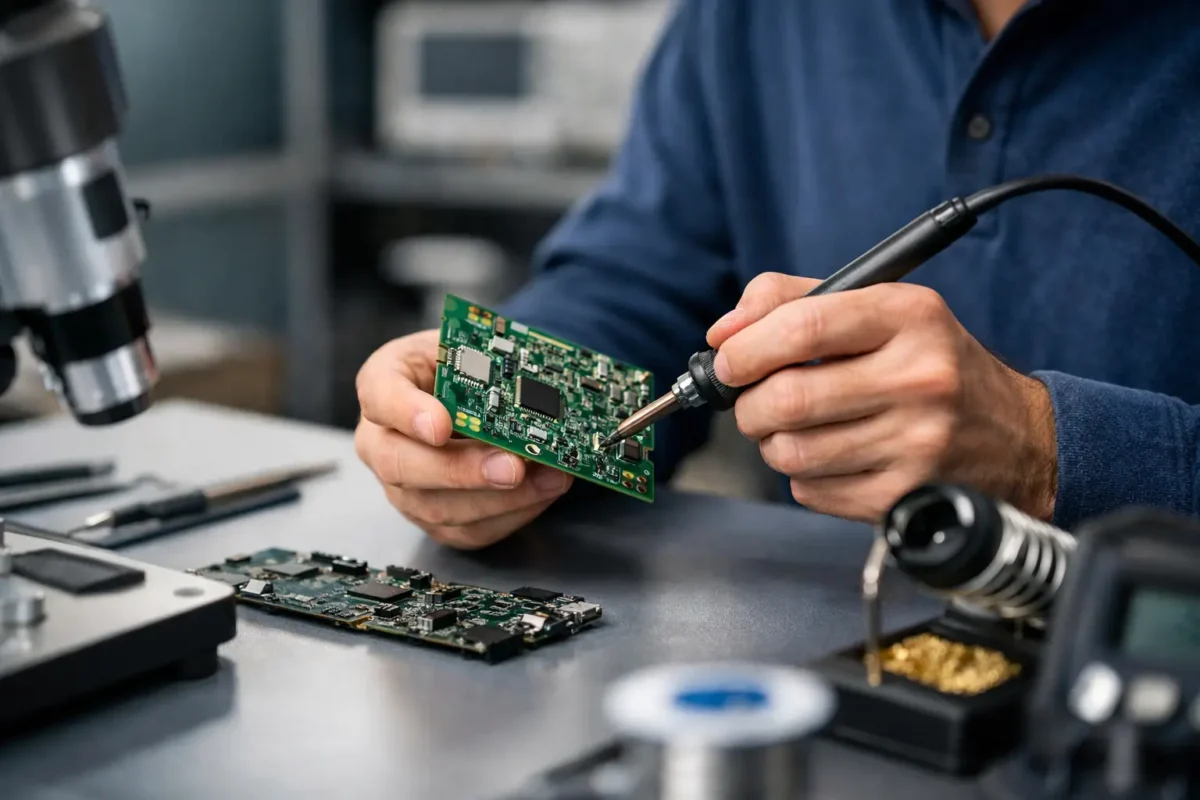
A laptop comes in dead after a charging port failure. A game console powers on but shows no video. A DJ controller works fine except for one damaged channel. In all three cases, the big question is the same: is component level repair worth it, or are you better off replacing the whole board or the whole device?
The honest answer is that it depends on the device, the failure, and the quality of the shop doing the work. But for a lot of electronics, especially expensive or hard-to-replace gear, component-level repair can be the smartest move by a wide margin.
What component-level repair actually means
Component-level repair is exactly what it sounds like. Instead of swapping an entire board, a technician diagnoses the failed parts on that board and repairs the problem directly. That might mean replacing a burned capacitor, a failed MOSFET, a damaged HDMI encoder, a shorted charging circuit, a lifted pad, or a broken trace.
This is different from the approach many shops take. Board swap repair is faster when parts are available, but it is also blunt. If one small section fails, replacing the entire board may fix it, but it can also cost far more than necessary. On some devices, replacement boards are expensive, unavailable, or carry their own hidden problems.
True board repair takes more skill. It requires testing, reading schematics when available, tracing power rails, checking for shorts, and doing precise soldering work without causing new damage. That is why the value of component-level repair depends heavily on who is doing it.
Is component level repair worth it for most devices?
For many customers, yes – especially when the device is valuable, specialized, or no longer easy to replace.
If you own a gaming laptop, MacBook, custom PC motherboard, current-gen console, or professional DJ equipment, the replacement cost can be steep. In those cases, repairing the exact failed section often costs less than replacing a whole mainboard, and a lot less than replacing the entire device.
It also matters when the hardware has value beyond its price tag. Maybe your laptop contains critical business data. Maybe your console has been impossible to replace at a fair price. Maybe your mixer or controller is part of your paid setup and downtime is costing you work. A repair that restores function without forcing a full replacement is often worth it even before you compare parts pricing.
That said, not every board problem should be repaired. If the board has severe liquid damage across multiple circuits, heavy corrosion, prior botched repair attempts, or catastrophic multilayer PCB damage, the labor involved can outweigh the value of the device. A good shop should tell you that plainly.
When component-level repair makes the most sense
The strongest case for board repair usually comes down to economics and availability.
A common example is a laptop with a charging issue. If the actual failure is a small charging IC or a few shorted components near the power input, replacing the entire motherboard would be overkill. The same logic applies to HDMI failures on consoles, damaged USB-C circuits, blown backlight circuits, and many no-power conditions.
It also makes sense when replacement boards are either unavailable or unreliable. On some devices, donor boards are harvested from used equipment with unknown history. You may end up paying for a replacement board that has its own defects, mismatched revisions, or hidden wear. Repairing the original board can be the better long-term move because it preserves the device you already know.
Specialized equipment is another clear case. Pro audio and DJ gear often has limited parts supply, high replacement cost, and a long useful life when repaired properly. If one failed component is taking down an otherwise solid unit, board-level work is often the only practical option.
When replacement is the better call
There are times when replacement wins.
If the device is low-value and the repair is labor-intensive, the math may not work. Spending serious money to repair a bargain laptop motherboard rarely makes sense when a better replacement system is available for close to the same price.
Replacement may also be better when the damage is widespread. A surge event, heavy liquid intrusion, or board crack can affect multiple subsystems at once. Even if one fault is repaired, another damaged area may fail later. That does not mean repair is impossible, but it does change the risk profile.
Then there is the time factor. Some customers need the fastest possible turnaround. If a known-good replacement board is immediately available and priced reasonably, swapping it may be the faster path. The right answer is not always the most technically elegant one. It is the one that best fits the customer’s budget, timeline, and goals.
The hidden factor: diagnostic quality
This is where a lot of people get burned. The real question is not just whether component-level repair is worth it. It is whether the shop has the skill to diagnose accurately before touching the board.
Poor diagnostics create expensive mistakes. A shop may replace the wrong chip, miss a short on another rail, or declare a board unrepairable because they do not have the tools or training to go deeper. That makes board repair look risky when the real problem is weak process.
A competent repair team starts with symptom verification, inspection, power analysis, and targeted testing. They isolate the failure before quoting major work. They also know when to stop. Not every board should be forced through a repair if the likelihood of a stable result is low.
That is one reason many customers choose specialists over general electronics shops. At Amazing Technology Group, this kind of work matters because difficult repairs are handled in-house instead of being treated like a guess-and-check parts swap.
Cost, reliability, and long-term value
Customers usually focus on repair price first, which is fair. But value is bigger than the initial invoice.
A successful component-level repair can deliver strong long-term value because you are fixing the actual failed area rather than replacing large assemblies unnecessarily. That often means lower cost, less waste, and preservation of original hardware.
Reliability depends on the nature of the repair. Replacing a failed charging IC and restoring damaged pads can be a solid, lasting repair when done correctly. Rebuilding a heavily corroded liquid-damaged board with multiple compromised zones is less predictable. Both may be possible, but they are not equal in risk.
This is where honest communication matters. A good technician explains whether the failure appears isolated or whether it may be part of a larger pattern. Customers do better when they understand not just the price, but the likely outcome.
Is component level repair worth it for gaming systems, laptops, and pro gear?
For gaming systems, often yes. Console HDMI failures, power issues, and damaged ports are classic examples where a board-level fix can save a system that would otherwise be replaced. If the storage is tied to the board or the console is difficult to source, repair becomes even more attractive.
For laptops and desktops, it depends on the machine. Higher-end systems, custom builds, and business-critical computers are strong candidates because replacement cost is high and downtime matters. For very old or low-spec systems, replacement may be more practical.
For pro gear, board repair is frequently the best option available. Audio equipment, mixers, and controllers are expensive, specialized, and often worth keeping in service for years. If a failed component is the only thing standing between dead gear and a working rig, repairing at the board level makes a lot of sense.
What to ask before approving the repair
Before you authorize the work, ask how the fault was diagnosed, whether the issue appears isolated, and what the realistic success rate looks like. Ask whether the quoted repair is based on confirmed testing or just a common-failure guess.
You should also ask what happens if the board has additional damage once repair begins. That does not mean the shop is being evasive. It means electronics can reveal more once the first fault is cleared, especially after liquid damage or electrical surge events.
A professional shop will not promise miracles. They will give you a clear process, set expectations, and tell you when replacement is the smarter move.
Component-level repair is worth it when it solves a specific failure on hardware that still deserves to be in service. It is not magic, and it is not the right answer every time. But when the diagnosis is solid and the work is done by people who know board repair at a real engineering level, it can save money, preserve important equipment, and keep good hardware out of the scrap pile. If your device has real value, the smartest next step is not guessing – it is getting it properly diagnosed.