

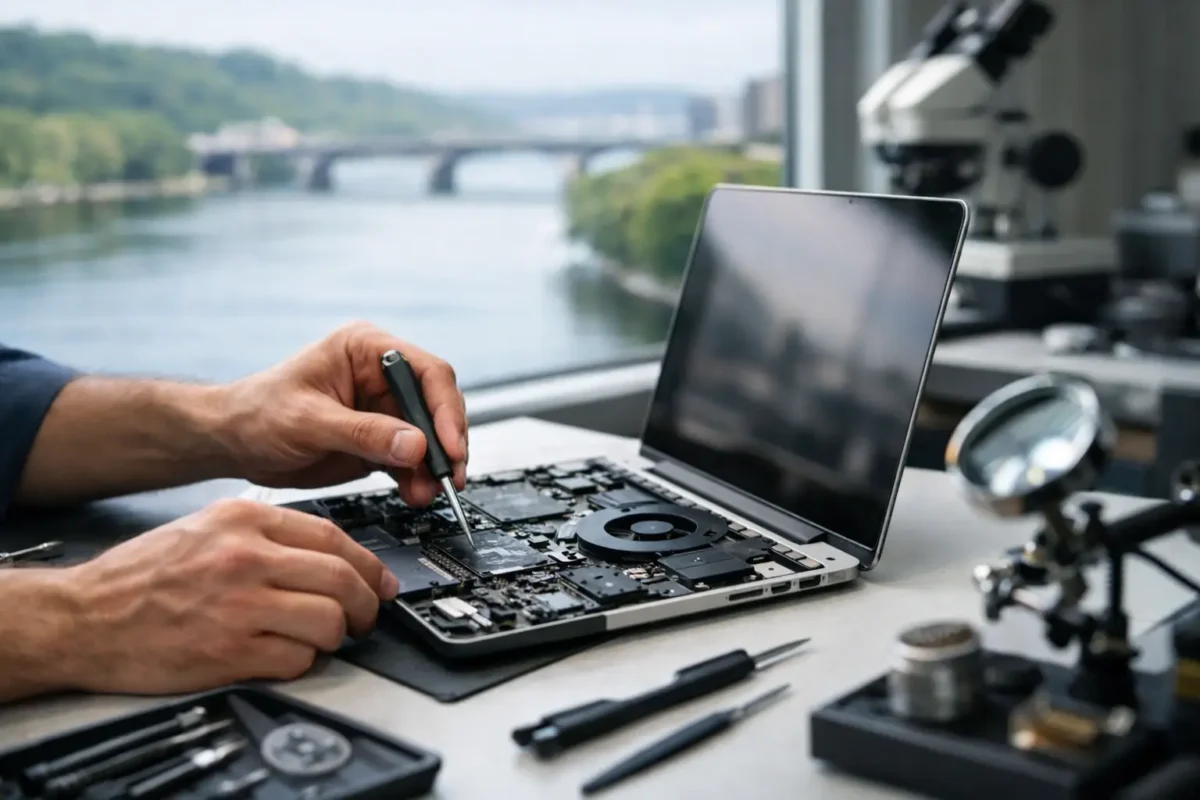
A laptop that suddenly stops charging, overheats without warning, or dies after a spill rarely needs guesswork. It needs real diagnosis. That is what separates basic Riverside laptop repair from the kind of repair work that actually saves machines people rely on for school, work, gaming, and business.
A lot of shops start and stop with the obvious. If the screen is cracked, they replace the screen. If the drive is dead, they replace the drive. That works for straightforward damage, but plenty of laptop failures are not straightforward. Power faults, charging issues, liquid damage, no-display conditions, random shutdowns, bad USB ports, BIOS problems, and board damage often get misread as total loss. In many cases, the real issue is smaller, more specific, and repairable.
That matters if you are trying to avoid replacing an expensive system, recover important data, or keep a business machine in service without unnecessary downtime.
What good Riverside laptop repair actually looks like
A proper repair process starts with diagnosis, not assumptions. If a laptop will not power on, there are several possible causes. The battery may be failing. The DC jack may be damaged. A charging circuit on the motherboard may have failed. A shorted component may be preventing power-up. Sometimes the issue is simple. Sometimes it is board-level.
Without testing, every one of those problems can look the same from the outside.
That is why experienced technicians work from symptoms to root cause. They check the power path, inspect for physical damage, test memory and storage, verify thermal behavior, and look for signs of component failure on the board itself. If the laptop suffered liquid damage, they do not just dry it off and hope for the best. They inspect corrosion, clean affected areas properly, and determine whether the damage reached charging, backlight, or data circuits.
This approach usually saves customers money because it avoids replacing parts that were never the issue in the first place. It also improves the odds of a stable repair instead of a temporary patch.
The difference between part swapping and board-level repair
This is where many repair experiences split in two.
Part swapping has its place. If a keyboard is physically broken, replacing it makes sense. If a screen is cracked, a new panel is often the right answer. But when a shop treats every laptop problem as a replace-the-big-piece problem, costs climb fast and viable machines get written off too early.
Board-level repair is different. Instead of replacing the entire motherboard because the laptop will not charge, a skilled technician may identify a failed charging IC, damaged DC input section, blown fuse, shorted capacitor, or corrosion around a key circuit. Replacing the specific failed component can restore the machine at a fraction of the cost of a full board replacement, if replacement is even available.
There is a trade-off. Board repair takes technical skill, the right tools, and time spent diagnosing. It is not a shortcut. But for higher-end laptops, business systems, gaming machines, and devices with hard-to-source boards, that extra effort can be the difference between recovery and replacement.
Common laptop problems that need deeper diagnosis
Some laptop issues are obvious the moment you see them. Others hide behind vague symptoms.
A machine that powers on but shows no image could have a bad screen, failed backlight circuit, RAM issue, GPU fault, BIOS corruption, or motherboard damage. A laptop that runs hot may need more than fan cleaning. It could have a failing heat pipe, worn thermal compound, sensor issues, or a power regulation problem driving temperatures higher than normal. A battery that will not charge may not be a battery problem at all.
Liquid damage is another category where surface-level repairs fall short. Even a small spill can migrate into connectors, under chips, and across power rails. The laptop may seem fine at first, then fail days later as corrosion spreads. Fast action helps, but thorough inspection matters more than optimism.
Data concerns also change the repair strategy. If the laptop contains business files, creative work, accounting records, or family photos, preserving the drive and protecting recoverable data becomes part of the job. Sometimes the main goal is full restoration. Other times, the smartest move is securing data first and then deciding whether hardware repair makes financial sense.
Who benefits most from specialized laptop repair
Not every customer walks in with the same priorities.
Students usually need their system back without paying replacement-level prices. Remote workers need reliability because downtime hits paychecks. Gamers want thermal and performance issues fixed correctly, not covered up with a quick fan blast. Small businesses need a repair partner that understands urgency, data sensitivity, and the real cost of having a key employee without a working machine.
Then there are customers who have already been told no somewhere else. Those are often the best candidates for deeper diagnostics. If a laptop was declined because the motherboard is “bad,” that should not automatically be the end of the story. It may be beyond economic repair, but it may also be a targeted board fault that a better-equipped shop can handle in-house.
That in-house part matters. When diagnostics and board work stay under one roof, communication is cleaner, turnaround is easier to manage, and there is less finger-pointing if the failure is complex.
What to expect from the repair process
A strong repair experience is not just about technical skill. It is also about being clear with the customer.
The process should start with intake and symptom review. What happened before the failure? Was there a drop, spill, update, surge, or charging issue? Those details help narrow the problem faster. After that comes diagnosis. The technician confirms what is failing, what caused it, and what repair paths are realistic.
Once the issue is identified, the customer should get a plain-English explanation. Not everyone needs the schematic-level version. They do need to know whether the problem is minor, major, urgent, or likely to return because of underlying damage. They should also know whether the repair is a component-level fix, a replacement part job, a data-priority case, or a situation where replacement may be the smarter investment.
Approval comes next. No one likes surprise repair bills. Good shops explain the scope, quote the work, and wait for authorization before moving forward.
Then comes the actual repair, followed by testing. That final testing step matters more than people realize. A laptop that powers on once is not the same as a laptop that charges properly, runs at safe temperatures, recognizes all ports, holds stability under load, and returns to normal operation.
Why local service still matters
Mail-in repair has its place, especially for uncommon or advanced failures. But for many people in Riverside County, local service adds speed and peace of mind.
You can explain the symptoms directly. You can ask questions. If the machine is tied to your job or your business, there is real value in working with a team that understands urgency and can look beyond a canned checklist. Local support also makes follow-up simpler if the issue turns out to be part of a larger hardware problem.
For business clients, this matters even more. A laptop problem is rarely just one broken device. It can affect access, productivity, backups, software licensing, and network workflow. A repair provider with broader technical depth can spot those ripple effects before they become bigger problems.
That broader capability is where a company like Amazing Technology Group stands out. When a laptop problem reaches board level, power circuitry, data risk, or more advanced diagnostics, the work is handled like an engineering problem, not a retail transaction.
When repair is worth it and when it is not
Honest repair advice includes saying no when no is the right answer.
If the laptop is low-value, heavily damaged, and likely to need multiple major parts, replacement may be the smarter call. If the motherboard is repairable but the screen, battery, and hinge assembly are also failing, the numbers may stop making sense. On the other hand, if the machine is a premium laptop, a specialized workstation, a business-critical system, or a gaming unit with good specs, repair often makes far more sense than starting over.
Age matters, but not as much as people think. A well-built laptop with a specific board fault may still be worth repairing. A newer budget model with widespread damage may not be. The right answer depends on value, condition, parts availability, and what the customer needs from the machine after repair.
That is why real diagnosis comes first. It keeps decisions grounded in facts instead of guesswork.
If your laptop matters, do not settle for a repair process built on assumptions. The best fix is not always the fastest guess or the biggest replacement part. Sometimes it is the careful, skilled work that gets to the actual failure and brings the machine back for the right reason.