

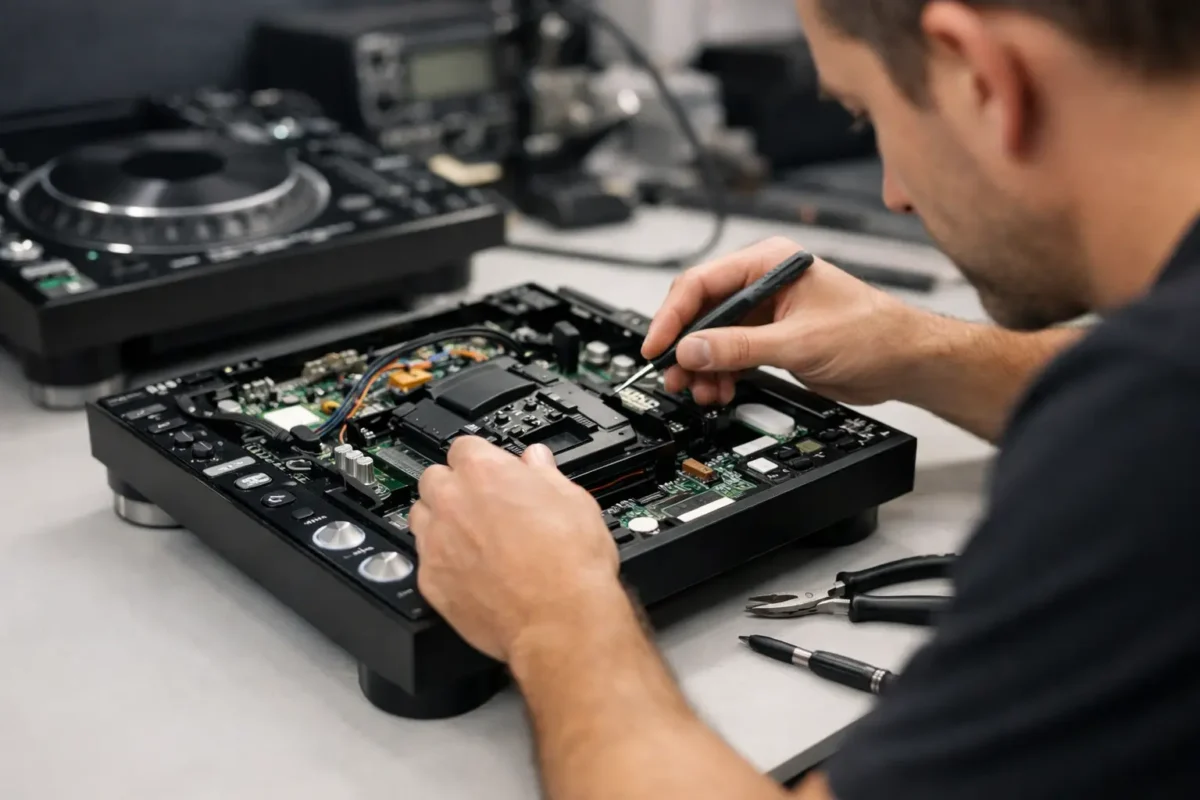
When a Denon player starts freezing mid-set, stops reading media, or develops a bad jog wheel, the problem usually goes deeper than a dirty button or a loose cable. A proper denon cdj repair service starts with real diagnosis, not guesswork, because professional DJ gear fails in ways that are often electrical, mechanical, and firmware-related at the same time.
That matters if you use your equipment to work, practice, or perform. Replacing a full media player because of a power fault, failed port, bad display section, or damaged control board is expensive. It is also often unnecessary. The right repair approach can bring the unit back reliably without treating the whole deck like a disposable product.
What a denon cdj repair service should actually include
A lot of repair shops talk about service, but what they really mean is part swapping. If the failure is obvious and the part is easy to source, that can work. But Denon DJ players are not simple consumer gadgets. They are layered systems with power regulation, digital processing, I/O sections, displays, mechanical controls, and board-level components that all have to communicate correctly.
A serious repair process starts by confirming the fault, checking for related failures, and isolating the actual cause. If a unit will not boot, for example, the issue could be a power supply rail, a shorted component, a corrupted storage device, a damaged connector, or a fault somewhere in the main board. Swapping one board without verifying the root problem can waste money and still leave the player unreliable.
Good service also includes inspection for wear that may not be the original complaint. A customer might bring in a deck for audio dropouts, but a technician may also find worn tact switches, liquid contamination, or stress damage near the USB or Ethernet ports. Catching that early protects the repair investment.
Common Denon player problems we see
Some failures are obvious the moment the unit powers on. Others only show up after the player warms up, reads a drive, or gets used under pressure. That is why testing matters.
Boot issues are one of the most common complaints. The player may hang on startup, loop during boot, or fail to initialize correctly. In some cases the fault is tied to the power section. In others it is a storage, firmware, or logic board issue.
Media reading problems are also common. A deck may stop recognizing USB drives, disconnect intermittently, or fail to load tracks consistently. Sometimes the port itself is physically damaged. Sometimes the damage is on the board behind the port, especially after repeated cable stress or a rough insertion.
Jog wheel and control problems show up in several ways. You might see lag, inaccurate response, missed touch detection, erratic scrolling, or physical resistance. That can come from worn mechanical parts, contamination, sensor issues, or deeper board faults.
Audio problems can be harder to pin down. Distorted output, one dead channel, low signal, headphone cue issues, or random muting may point to bad jacks, damaged output stages, cracked solder joints, or failing components in the audio path.
Display and button issues are another big category. Unresponsive transport controls, dim or dead screens, intermittent LEDs, and menu navigation faults can all affect usability. Some are straightforward. Others are tied to ribbon cable damage, failed regulators, or board-level faults that need proper bench work.
Why board-level repair makes the difference
Denon DJ equipment is expensive enough that the repair strategy matters almost as much as the repair itself. If a shop only knows how to replace complete assemblies, the quote can rise fast. If the assembly is discontinued or hard to source, the job may get rejected entirely.
Board-level repair changes that. Instead of replacing a whole board because one section failed, a skilled technician can test the circuit, identify the failed component or damaged area, and repair the board directly when appropriate. That may involve micro-soldering, trace repair, connector replacement, power circuit work, or rework on damaged PCB sections.
This is not the right move in every case. Sometimes a full assembly replacement is still the smarter option if the damage is widespread or the cost balance favors it. But without board-level capability, you never get that choice. You just get the expensive answer first.
For working DJs, that difference is real. Saving a main board, repairing a torn connector, or restoring a damaged I/O section can keep a valuable player in service without turning a manageable fault into a replacement-level bill.
The repair process should be clear from the start
Customers should not have to guess what happens after they drop off a deck or ship one in. A professional repair workflow is straightforward.
First comes intake and symptom review. That means documenting the problem, noting any physical damage, and understanding whether the issue is constant or intermittent. If the unit has a history, such as a liquid spill, power surge, or previous repair attempt, that needs to be part of the picture.
Next comes diagnostic work. This is where real technicians separate symptoms from causes. The player is inspected, tested, and measured. Problem areas are identified, and the shop determines whether the fault is mechanical, electrical, software-related, or a combination.
After diagnosis, the customer should get a clear explanation of the repair path and cost authorization before major work proceeds. That keeps expectations realistic and avoids surprise billing.
Then the actual repair is completed in-house, followed by verification. That final stage matters more than people think. A Denon player should not just power on at the bench. It should be tested through the functions related to the original complaint, including media reading, control response, audio output, display behavior, and stability over time where needed.
Why some Denon repairs fail the second time
A lot of repeat failures come from incomplete work. The obvious issue gets addressed, but the underlying reason it happened is ignored. A replacement USB port, for example, is not enough if the board pads are damaged or the surrounding circuit has stress cracks. A new button does not solve much if contamination undercuts neighboring switches and causes intermittent operation later.
Another common problem is heat damage from poor soldering technique or rushed work on compact boards. DJ equipment is dense, and the wrong tools or methods can create a second repair issue while trying to fix the first one.
There is also the simple reality that intermittent faults require patience. A deck that fails once every hour needs more than a quick power-on check. It needs testing under conditions that reproduce the complaint. That takes time, but it is how real repair work gets done right.
When repair makes sense and when it may not
Most customers want the honest answer, not the sales answer. In many cases, repair is the better value, especially when the unit is high-end, the problem is isolated, or replacement cost is steep. That is particularly true for port damage, power issues, audio faults, button failures, and many board-level problems.
There are times when it depends. Severe liquid damage, heavily corroded boards, catastrophic impact damage, or units with multiple failed assemblies can push the economics in the wrong direction. Age and parts availability also matter. A good shop will tell you when a repair is solid, when it is marginal, and when replacement may be the more practical move.
That honesty saves customers money and protects trust. It also keeps people from throwing more time and cash into a unit that cannot reasonably be restored to dependable condition.
Choosing a shop for Denon CDJ repair service
The best shop is not the one with the broadest list of devices on the homepage. It is the one that can explain how the failure will be diagnosed and repaired. For Denon CDJ repair service, look for actual experience with DJ hardware, in-house board work, and a process that includes testing rather than just installation.
If your deck is used for gigs, ask whether the shop understands performance-critical issues like intermittent controls, unstable playback, output problems, and port reliability. Those are not cosmetic concerns. They are job-stopping failures.
If you are local to Riverside County or planning to mail in a unit, Amazing Technology Group handles complex electronics repairs with the kind of bench-level diagnostic work these players often need. That is the difference between hoping a repair holds and knowing it was properly worked through.
DJ gear takes abuse even when it is treated carefully. It gets packed, moved, powered up and down, and used in environments that are rough on electronics. A solid repair is not about making the unit look fixed for a day. It is about restoring the function that matters when the room is full, the set is live, and the deck has to do its job without excuses.