

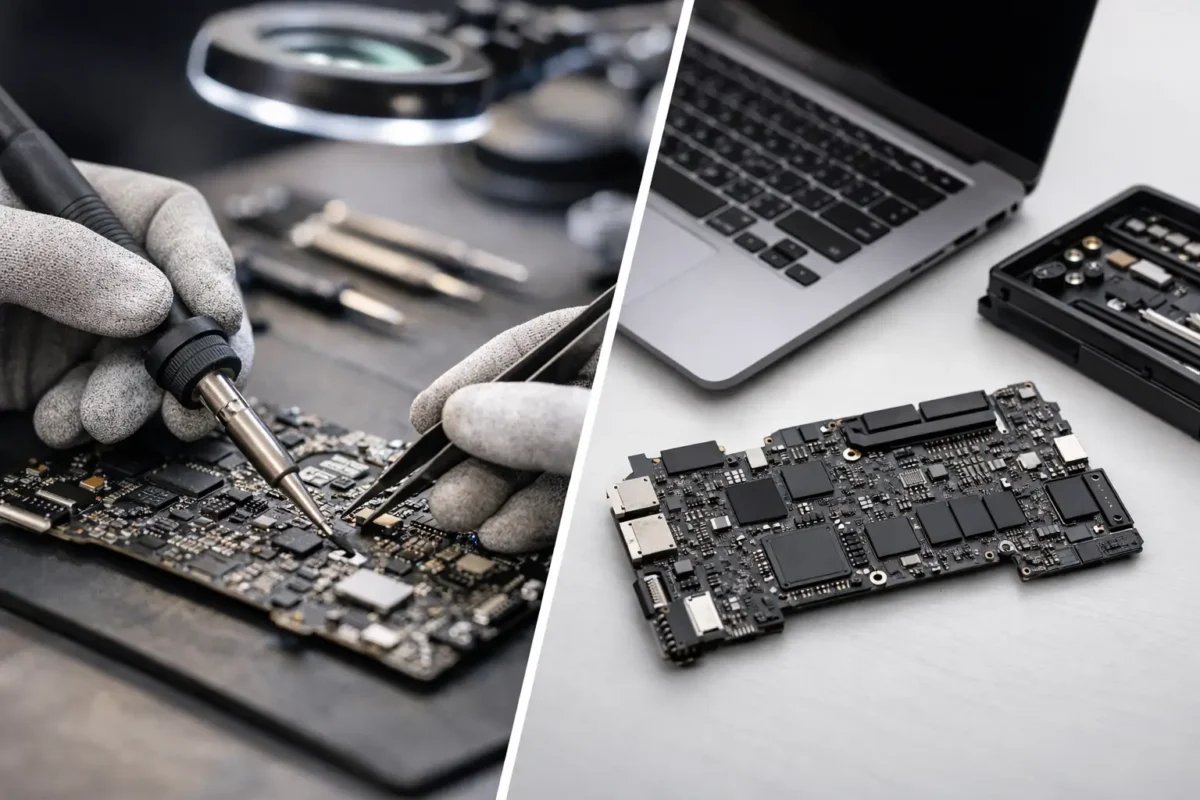
When a device lands on the bench with power issues, no display, charging failure, liquid damage, or random shutdowns, the real question is not just what broke. It is whether logic board repair versus replacement makes more sense for that specific machine. That answer depends on the fault itself, the value of the device, parts availability, turnaround time, and whether the original board can be restored safely and reliably.
A lot of shops skip straight to replacement because it is easier to quote. Swap the board, test basic function, move on. But that approach is not always the smartest one for the customer. On many laptops, desktops, game consoles, and specialty electronics, board-level repair can save money, preserve original hardware, and avoid the supply problems that come with trying to source a full replacement board.
Why logic board repair versus replacement is not a simple yes or no
A logic board is the central electronic platform that ties major functions together. Power rails, charging circuits, USB lines, video output, storage communication, RAM control, audio functions, and system management all live there. When one section fails, the whole device can look dead even if the damage is limited to a small group of components.
That is why logic board repair versus replacement should start with diagnostics, not assumptions. A blown fuse, shorted capacitor, failed MOSFET, damaged charging IC, corroded trace, or cracked connector can often be repaired without replacing the entire board. On the other hand, severe multilayer damage, widespread liquid corrosion, burned substrate, or chip-level failure in a hard-to-source area may push the job toward replacement.
Good repair work is about precision. Good advice is about knowing when precision is the better investment and when it is not.
When repair is the better move
Repair usually makes the most sense when the failure is isolated, the board is otherwise in good condition, and replacement boards are expensive, unreliable, or unavailable. This is common with newer laptops, gaming systems, DJ gear, and certain professional devices where replacement boards are either backordered or cost so much that they almost kill the economics of the whole job.
A proper board-level repair can target the actual failed section instead of throwing away an entire assembly. If a charging circuit is shorted, replacing that circuit may restore full function at a fraction of the cost of a whole board. If liquid entered near a connector and damaged a handful of components, cleaning, trace repair, and component replacement may be enough.
Repair can also be the better choice when the original board contains important paired components. Some devices tie storage, security, firmware, or device identity to the original board. A replacement is not always plug-and-play. In those cases, keeping the original board alive can prevent compatibility issues and reduce the chance of secondary problems.
For customers who care about value, this is where real diagnostics matter. You are not paying for guesswork. You are paying for someone to find the failed area, measure the board correctly, and fix what actually failed.
Cases where board repair often wins
Power and charging failures are strong candidates for repair because they often trace back to a limited set of components. Port damage is another common example, especially when the board itself is still healthy apart from torn pads or damaged traces around the connector. Moderate liquid damage can also be repairable if corrosion has not spread too far into hidden layers or under major chips.
Console issues such as no power, HDMI output failure, and damaged USB or charging circuitry often fall into this category too. So do many laptop failures that look catastrophic to the owner but turn out to be localized electronic faults.
When replacement is the smarter call
Not every board should be repaired. There are times when replacement is the more responsible recommendation.
If the board has severe physical damage across multiple layers, repair time can grow quickly while long-term reliability drops. The same is true when corrosion has spread under major ICs and into multiple sections of the board. You may be able to bring it back temporarily, but if the structure of the board has been compromised in several areas, replacement may offer a more stable outcome.
Replacement can also make sense when labor would exceed the cost of a known-good board. If a board is easy to source, reasonably priced, and does not create pairing or data issues, a replacement may be the faster and cleaner solution. For business users, downtime can be more expensive than hardware. In that situation, speed matters.
There is also a parts reality that customers do not always see. Sometimes the failed chip is unavailable, counterfeit risk is high, or the needed donor board is hard to justify economically. A technician can be capable of the repair and still recommend replacement because it is the better overall decision.
The risk with replacement boards
Replacement sounds simple, but it carries its own trade-offs. Used boards may have hidden faults. Refurbished boards vary a lot in quality. Some aftermarket options are poor enough to create a second repair later. If a shop treats every failure as a board swap, the customer may end up paying more for a weaker result.
That is why the source and condition of the replacement matter just as much as the idea of replacement itself.
Cost, data, and turnaround all matter
Customers usually ask one question first: which option is cheaper? Fair question, but cost is only one part of the decision.
Repair is often less expensive when the failure is limited and the board is worth saving. Replacement may cost more in parts but less in labor if the board is easy to obtain and install. The right answer depends on the failure path, not just the invoice total.
Data is another major factor. On many systems, especially laptops and certain integrated devices, a damaged board may still hold access to important files through board recovery or preservation of the original storage path. A full board replacement can complicate that. If the device contains critical business files, project work, recordings, or personal data, that changes the repair strategy.
Turnaround matters too. Some repairs can be completed quickly once the failure is identified. Others require specialized parts, micro-soldering work, or extensive cleaning and trace restoration. If replacement boards are in stock, replacement may be faster. If they are not, targeted repair may actually beat replacement.
What a real diagnostic process should look like
This is where good shops separate themselves from parts swappers. Proper diagnosis means confirming the symptom, checking for shorts, tracing power rails, inspecting for corrosion or physical damage, testing suspect circuits, and determining whether the failure is localized or systemic.
A technician should be able to explain what failed, what the repair path is, and what the risks look like. Not every job has a perfect guarantee, especially with liquid damage or severe electrical events, but the customer should still get a clear recommendation based on evidence.
At Amazing Technology Group, this kind of board-level thinking is the whole point. Difficult cases get worked in-house by technicians who understand component failure, not just assembly replacement. That matters when the device is expensive, specialized, or already turned away somewhere else.
How to decide without wasting money
If you are comparing logic board repair versus replacement, start with three practical questions. Is the original board likely repairable? Is a replacement board actually available in quality condition? And which option gives you the best balance of cost, reliability, and downtime?
If the shop cannot explain the failure beyond saying the board is bad, that is a warning sign. A bad board is a symptom description, not a diagnosis. You want to know whether the damage is isolated, whether repair is realistic, and whether replacement introduces other issues.
For gamers, creatives, DJs, and small businesses, the right call often comes down to preserving valuable hardware without overpaying for the easiest answer. That is especially true with devices that are expensive to replace, customized, or no longer supported well by the manufacturer.
The best repair decision is not the one that sounds simple. It is the one backed by testing, honest trade-offs, and the skill to fix what others write off. If your device is worth keeping, get it diagnosed by a team that knows the difference.