

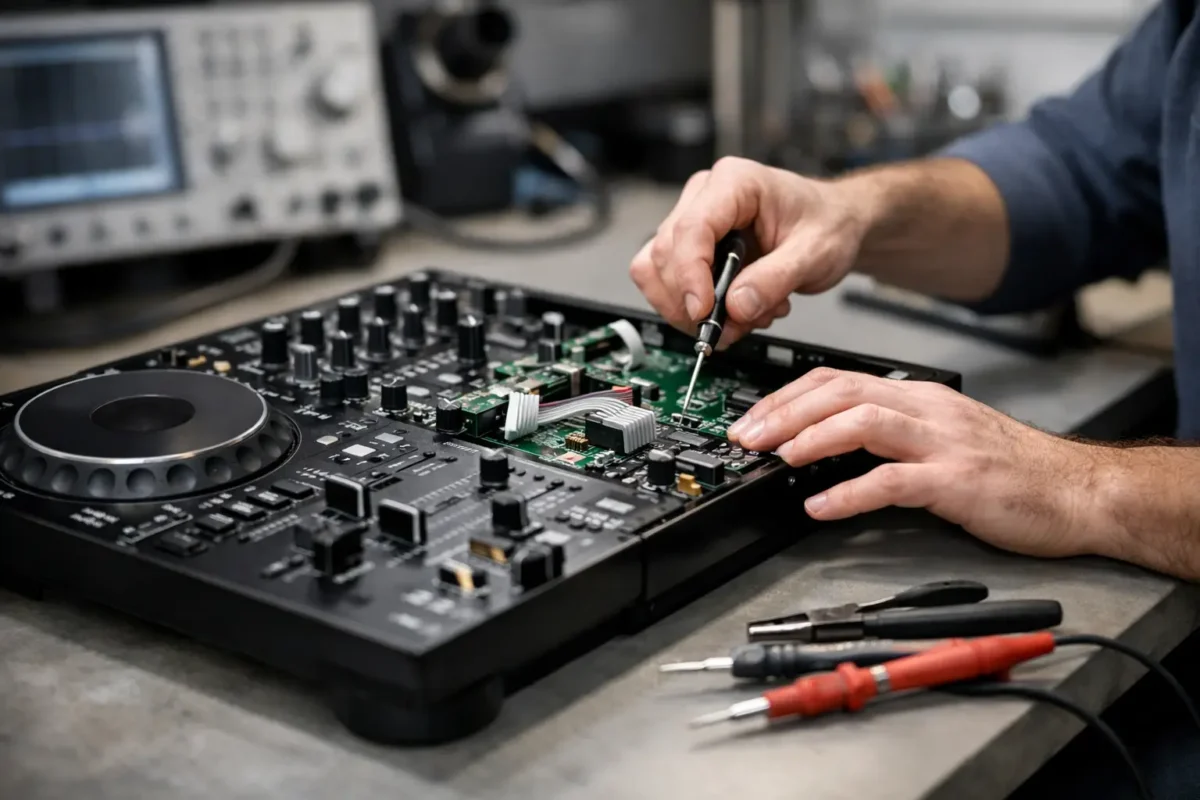
A Pioneer mixer usually does not fail all at once. It starts with a noisy channel fader, a cue button that works when it feels like it, an effects section that drops out, or a power issue that makes setup stressful right before a set. That is where proper pioneer dj mixer repair matters. If the problem is treated like a simple parts swap when the real fault is deeper on the board, the mixer may come back with the same issue or a new one.
For DJs, venues, and working audio professionals, a mixer is not just another piece of gear. It is the center of the rig. When it goes down, the question is not only whether it can be fixed. The real question is whether it can be fixed correctly, without wasted time, unnecessary replacement, or guesswork.
What goes wrong in a Pioneer DJ mixer
Most Pioneer mixer failures fall into a few categories, but the cause is not always obvious from the symptom. A dead unit might have a power supply problem, a shorted component, liquid damage, or damage that started after a bad cable event. A channel cutting in and out could be a worn fader, but it could also be a cracked solder joint, damaged board trace, or oxidation affecting the signal path.
Buttons and knobs are another common complaint. Some fail from normal wear. Others fail because the mechanical part is fine, but the board underneath has taken stress over time. On mixers that see heavy club use, impact damage, heat, liquid exposure, and rushed transport all add up. Even a mixer that looks clean on the outside can have serious internal damage.
Audio distortion is where basic repair shops often get stuck. Distorted output, weak headphone signal, missing channels, or noisy booth output can come from op-amp failure, damaged capacitors, connector issues, power rail instability, or board-level corrosion. Replacing one obvious part without tracing the full circuit is how bad repairs happen.
Pioneer DJ mixer repair is not just part replacement
This is the part many customers never get told clearly enough. Good pioneer dj mixer repair starts with diagnosis, not ordering parts and hoping for the best. If the mixer has a failed fader, that may be the only issue. But if the fader failed because liquid got into the assembly and onto the board, replacing the fader alone does not solve the whole problem.
That is why board-level service matters. Real diagnosis means checking power rails, testing signal flow, inspecting for damaged pads and traces, evaluating connectors, and verifying whether the control surface fault is isolated or tied to a larger issue. On some models, a symptom that looks simple on the front end can trace back to a much more specific fault deeper in the unit.
There is also a cost factor here. Full board replacement can be expensive, and on some older or professional models, replacement boards are hard to source or not practical at all. Component-level repair often gives customers a better option. Instead of writing off an otherwise solid mixer, the damaged section can sometimes be repaired directly, saving money and preserving the original unit.
Common symptoms that need a real bench diagnosis
If your mixer powers on but has no output, do not assume the master section is bad. If a cue light works but audio does not route correctly, do not assume it is only a button problem. And if the unit is fully dead, do not assume it is beyond repair.
The most common issues we see in pro DJ equipment include intermittent channels, failed crossfaders, non-responsive EQ controls, dead USB or digital sections, headphone jack problems, damaged input connectors, blown power sections, and liquid intrusion. Some of these are straightforward. Some are not. It depends on what failed first, how long the damage was left in place, and whether anyone already tried to repair it.
Previous repair attempts matter more than people think. Lifted pads, broken connectors, missing screws, incorrect parts, and poor solder work can turn a repairable unit into a more complex job. That does not always mean the mixer is done, but it does change the path forward. A serious shop should tell you that up front.
What a proper Pioneer DJ mixer repair process looks like
A professional repair process should be clear, not mysterious. First comes intake and symptom review. That includes the obvious complaint, but also usage history. Was there liquid exposure? Was the mixer dropped? Did the issue start after a power event? Did one channel fail before the rest? That context helps narrow the failure path.
Next comes internal inspection and electrical diagnosis. This is where experience matters. A technician should not only look for burned parts. They should check for corrosion, trace damage, loose connectors, mechanical wear, cracked solder joints, and unstable rails. On digital-capable mixers, they may also need to verify communication behavior between sections.
After diagnosis, the customer should get a clear explanation of what failed, what can be repaired, and whether the fix makes economic sense. That last part matters. Not every repair is worth doing, and a trustworthy shop says so when needed. But many mixers that get rejected elsewhere are still viable when the technician has the tools and skill to work at component level.
Then comes the actual repair, followed by testing under real use conditions. It is not enough to power the unit on and call it done. The mixer needs channel verification, control testing, output testing, and enough bench time to catch intermittent behavior. A rushed repair is how gear fails again when it is back in service.
When repair beats replacement
For entry-level gear, replacement can sometimes make sense. For higher-end Pioneer mixers, that calculation changes fast. These units are expensive, and many owners already know exactly how their mixer feels and responds. Replacing it may cost far more than repairing a localized failure.
There is also the issue of availability and setup continuity. A venue or working DJ may not want to reconfigure around another model. Even if a replacement is possible, keeping a known, preferred mixer in service often makes more sense than starting over.
That said, not every unit should be repaired at any cost. Severe liquid damage across multiple sections, major board destruction, or extensive failed prior work can push a mixer past reasonable economics. The right answer is not always yes. The right answer is an honest diagnosis.
Choosing a shop for Pioneer DJ mixer repair
If a shop handles DJ equipment, ask how they diagnose faults. Ask whether they do board-level repair in-house or send everything out. Ask what happens if the problem turns out to be more than a bad fader or jack. These are not small details. They tell you whether the shop is actually built for complex electronics work or just basic replacement tasks.
This is where companies like Amazing Technology Group stand apart. When a repair stays in-house and is handled by technicians who are comfortable with advanced diagnostics, micro-soldering, and PCB repair, customers get a better shot at a real fix. That matters for gear other shops refuse, misdiagnose, or treat as disposable.
Turnaround also matters, but speed should not come at the expense of accuracy. If the mixer is mission-critical, you want updates, a real diagnosis, and work that holds up after the first event back. Fast is good. Fixed is better.
How to protect your mixer after repair
Once the unit is back in service, a little discipline goes a long way. Use proper cases, avoid pressure on knobs and shafts during transport, and keep drinks away from the booth whenever possible. Clean external surfaces carefully and avoid spraying anything directly into controls unless the service method is correct for that component.
Power quality also matters. Dirty power and bad adapters create problems that look random until they are not. If your setup moves between venues, protect the gear accordingly. A repaired mixer can run for years, but only if the same failure conditions are not repeated every weekend.
If your Pioneer mixer is acting up, do not wait for a total failure before getting it checked. Small faults tend to grow, and the earlier a technician sees the problem, the better the odds of a clean, cost-effective repair.