

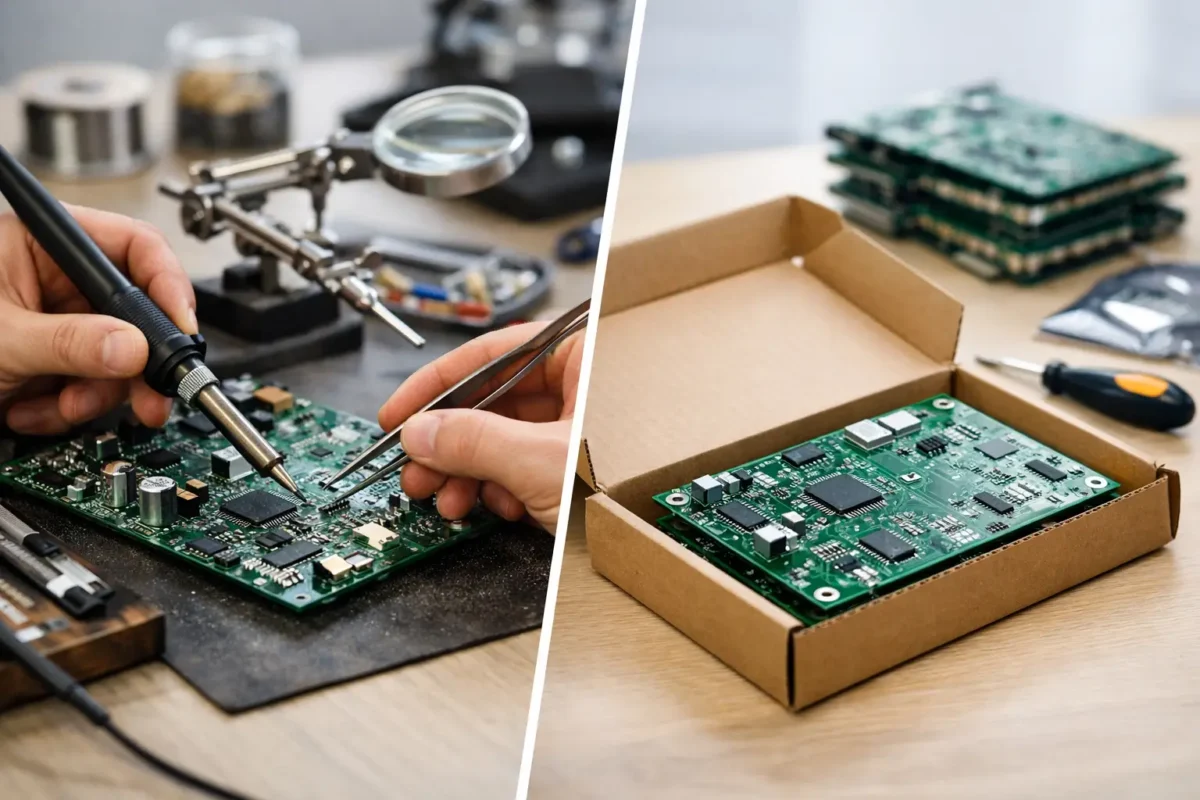
A dead motherboard in a gaming PC, a no-power PS5, a DJ controller with a burned section on the PCB – these are the moments when board repair vs replacement stops being a theory and becomes a money decision. Most people are not asking for the perfect technical answer. They want to know what gets the device working again without wasting time or paying for the wrong fix.
That decision is not as simple as repair is cheaper and replacement is safer. Sometimes board-level repair saves a device that would otherwise be scrapped. Sometimes replacing the board is the only responsible move. The right call depends on the failure itself, the value of the device, parts availability, data or configuration tied to the board, and whether the person doing the work can actually diagnose at the component level instead of guessing.
Board repair vs replacement starts with diagnosis
If nobody has identified the actual fault, any quote is just a rough opinion. A board can fail because of a shorted capacitor, a bad MOSFET, damaged traces, liquid corrosion, a failed port, a cracked connector, a blown fuse, or a larger chipset issue. Those are very different repair paths, even though the symptom may look the same from the outside.
This is where a lot of bad decisions get made. Some shops jump straight to replacement because that is faster for them if a whole board is available. Others promise repair without confirming whether the failure is localized or spread across multiple circuits. Good board work starts with real testing – voltage rail checks, short detection, visual inspection under magnification, continuity testing, thermal checks, and when needed, schematic-based tracing.
If the fault is isolated and accessible, repair often makes strong financial sense. If the board has widespread liquid damage, multilayer internal damage, severe heat damage, or a failed chip that is not realistically replaceable, replacement may be the better route.
When board repair is usually the better value
Board repair tends to make the most sense when the device itself is worth preserving and the failure is limited to specific components or circuits. That is common with laptops, custom PCs, consoles, DJ gear, and other electronics where replacing the full board is expensive, hard to source, or introduces other problems.
A simple example is a damaged charging circuit on a laptop motherboard. Replacing a few failed components can cost far less than sourcing a whole replacement board. The same goes for HDMI port damage on a game console, power section failures on pro audio gear, or broken controller board connections. In these cases, the board is not beyond saving. It just needs skilled component-level work.
Repair also has an advantage when replacement boards are used, pulled, or of uncertain quality. A replacement board might solve one issue while bringing in another, especially with donor parts from salvage stock. On older equipment, replacement boards may already be living on borrowed time. A clean repair to the original board can be more predictable because you are fixing a known failure instead of gambling on an unknown board.
There is also the issue of compatibility. Some boards are tied to serials, firmware, calibration data, security chips, or hardware matching. Swapping the board can create extra steps or leave certain functions broken. That matters on some laptops, consoles, DJ hardware, and business equipment where the board is not just a generic part.
When replacement is the smarter move
There are times when replacing the board is the practical answer, and pretending otherwise does not help the customer. If the board has extensive corrosion across multiple zones, severe physical damage, or internal layer failure from impact or electrical events, repair can become too time-consuming and too uncertain.
Replacement also makes sense when the cost of labor needed for advanced repair gets too close to the price of a good replacement board. This can happen on certain consumer devices where boards are common and affordable. If a tested, reliable replacement is available quickly and installs cleanly, that may reduce downtime and lower overall risk.
Business clients often care about turnaround as much as repair cost. If a workstation or network appliance is mission-critical, the fastest dependable path may be replacement first, especially if every day offline costs real money. In that situation, repair is not always the wrong answer, but the value calculation changes.
Another factor is repeat reliability. If one section of the board failed because of a larger design weakness or because multiple surrounding components have already been stressed, a single repair may not restore long-term confidence. A replacement board, if known good and properly sourced, can sometimes offer a cleaner reset.
Cost is more than the invoice
People usually compare repair and replacement by asking which quote is lower. That matters, but it is only part of the picture. The better question is total cost.
A replacement may cost more upfront but reduce downtime. A repair may cost less upfront and preserve data, firmware matching, or existing configuration. On the other hand, a cheap replacement from an unverified source can turn into a second repair bill later. The lowest number on day one is not always the least expensive outcome.
For gaming systems and custom computers, there is also the issue of preserving the rest of the build. If a board-level fault can be repaired cleanly, you may avoid unnecessary replacement of paired parts or the headache of rebuilding around a different board revision. For professional gear, especially DJ equipment, keeping the original board can protect fit, feature behavior, and equipment consistency.
This is why experienced shops do not treat every dead board like a parts catalog problem. They look at the repair path, the replacement path, the time involved, the source quality of parts, and the realistic life expectancy after the work is done.
Board repair vs replacement for different devices
The type of device changes the answer.
For laptops and desktops, board repair is often attractive when the fault is in the power circuit, charging section, backlight circuit, or a physically damaged port area. Replacement becomes more appealing when the board is common, affordable, and not tied to critical data or unique configuration.
For consoles like PS4, PS5, and Xbox systems, board repair is often the preferred path for HDMI damage, power faults, and certain no-boot conditions. Full board replacement can be harder than it sounds because of pairing, availability, and donor board quality.
For controllers, repair usually wins when damage is isolated to charging ports, broken pads, stick circuit issues, or trace damage. Replacement may make more sense if the board is heavily corroded or if the controller itself is low enough in value that labor outweighs the benefit.
For DJ equipment and other pro electronics, repair has a strong case because replacement boards can be expensive, unavailable, or discontinued. On specialized gear, component-level repair is often what keeps the equipment in service at all.
The skill of the shop changes the answer
This part gets overlooked all the time. Board repair vs replacement is not just about the device. It is also about who is doing the work.
A shop that mainly swaps assemblies will naturally lean toward replacement. A shop that performs real board-level diagnostics, micro-soldering, PCB trace repair, and BGA rework can see repair opportunities others miss. That does not mean every board should be repaired. It means the customer gets a real evaluation instead of a default answer.
That distinction matters because poor diagnosis creates false choices. If someone cannot find the failed component, they may say the whole board is dead. If someone lacks the tools or experience to rebuild pads, replace fine-pitch parts, or correct prior failed repair attempts, they may recommend replacement even when repair is fully viable.
A serious repair process should be transparent. What failed, what is being tested, what parts are needed, what the risks are, and whether repair or replacement offers the better outcome – that should all be explained in plain language.
How to make the right call
If you are deciding between repair and replacement, start with four questions. Is the fault isolated or widespread? Is a reliable replacement board actually available? Will a board swap create compatibility, pairing, or data issues? And does the shop have proven board-level capability, not just part-swapping experience?
If the failure is localized, the original board has value, and the repair is being handled by technicians who do this work in-house, repair is often the smarter investment. If the damage is extensive, the replacement is tested and cost-effective, and downtime is the bigger concern, replacement may be the better move.
At Amazing Technology Group Inc., this is exactly why real diagnosis comes first. Customers do better when the answer is based on the board in front of us, not on a shortcut.
The best repair decision is usually the one that respects both the hardware and your budget. Not every board should be saved, but plenty of boards get replaced every day when they could have been repaired correctly.